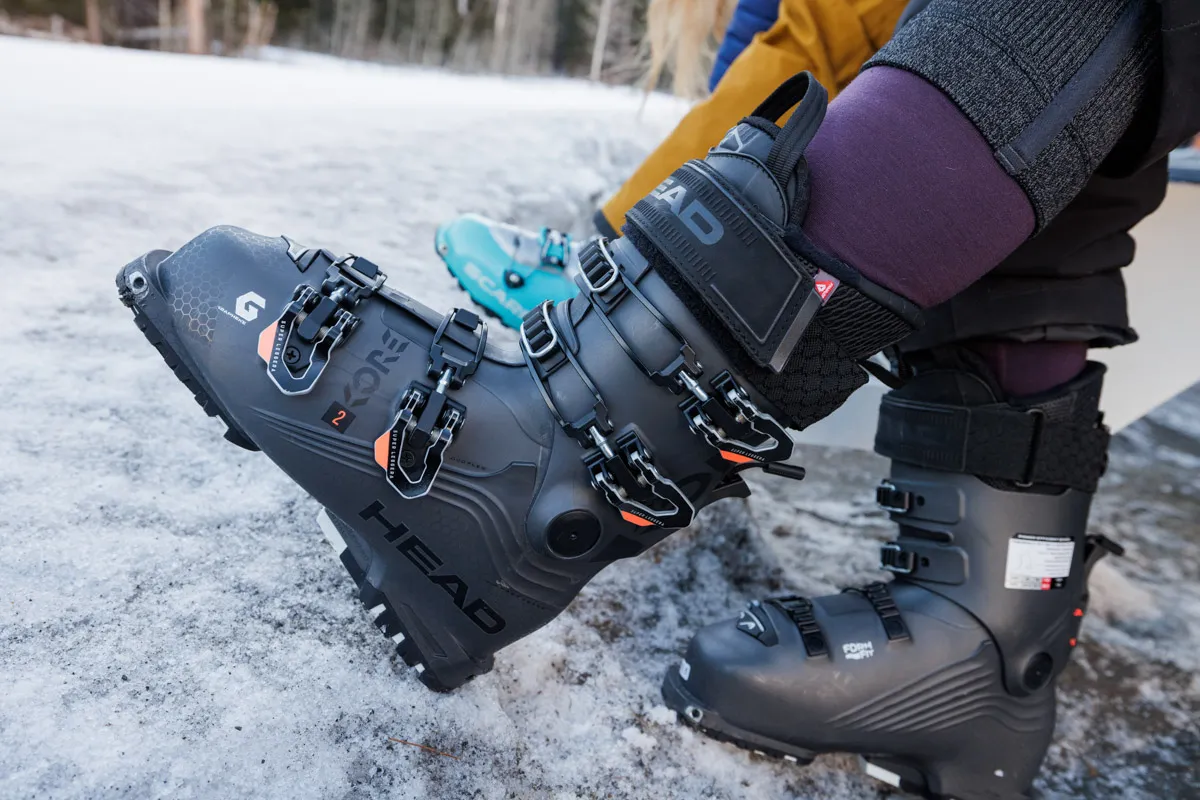
A Definitive Guide to the Best Ski Boots for Beginners (2026)
Best Ski Boots for Beginners. The primary interface between a skier and their equipment is not the ski itself, but the boot. For the novice, this component represents the most significant variable in determining the trajectory of their technical progression. While much of the industry’s marketing focus remains on the aesthetic and aerodynamic properties of skis, the boot functions as the command center, translating the subtle bio-mechanical inputs of the lower leg into the kinetic energy required to manipulate a high-tension edge.
Identifying the appropriate hardware at the start of one’s tenure on the mountain requires a departure from the “comfort-first” mentality that dominates general consumer retail. A boot that feels like a house slipper in the showroom will almost certainly fail to provide the structural integrity required to control a ski on a steep, icy gradient. Conversely, an overly rigid boot—mimicking the specifications of a World Cup racer—will effectively “lock out” the beginner’s ability to flex their ankles, leading to a defensive, rear-weighted stance that is the hallmark of technical stagnation.
This inquiry serves as a definitive pillar for understanding the mechanics of early-stage footwear selection. We will move beyond the superficial metrics of color and brand prestige to examine the interplay of shell plastics, liner density, and last width. By treating the boot as a technical system rather than a piece of apparel, the emerging skier can make a selection that balances immediate thermal comfort with the long-term necessity of precise power transmission.
Understanding “best ski boots for beginners.”
The industry often markets “beginner” gear as a simplified, lower-cost version of professional equipment. However, when we analyze the best ski boots for beginners, we must view them through the lens of “forgiveness vs. feedback.” A beginner needs a boot that is soft enough to allow for errors in balance but responsive enough to signal when an edge has been successfully engaged. The oversimplification of this category often leads to the “rental trap,” where soft, degraded plastics provide zero lateral stability, forcing the user to use their skeletal structure rather than their musculature to stay upright.
Misunderstandings frequently arise regarding the “Flex Index”—a non-standardized numerical rating of the boot’s resistance to forward pressure. Beginners are often told to look for a “low flex” (typically 60-80), but this ignores the user’s mass and height. A 220-pound beginner will collapse a 70-flex boot instantly, whereas a 110-pound beginner might find an 80-flex boot entirely immovable. The “best” option is therefore a calculation of leverage, not just a label on a box.
True mastery of this selection process also involves acknowledging the “Last”—the width of the boot at the forefoot. High-performance boots are historically narrow (97mm-98mm), while beginner-oriented models are wider (102mm-104mm). While a wider last is more comfortable for the average foot, excessive volume inside the boot allows the foot to slide, which creates a “lag” in steering. Finding the best hardware requires navigating this narrow corridor between vascular health and mechanical precision.
The Evolution of the Polyurethane Shell
The transition from leather lace-up boots to the plastic overlap shell in the 1960s was the single most important advancement in alpine safety and performance. Early plastics were brittle and temperature-sensitive, often becoming impossibly stiff in extreme cold or dangerously soft in the spring sun. Modern materials, such as Pebax and high-grade Polyurethane (PU), offer a more consistent “progressive flex”—the idea that the further you push into the boot, the more it resists.
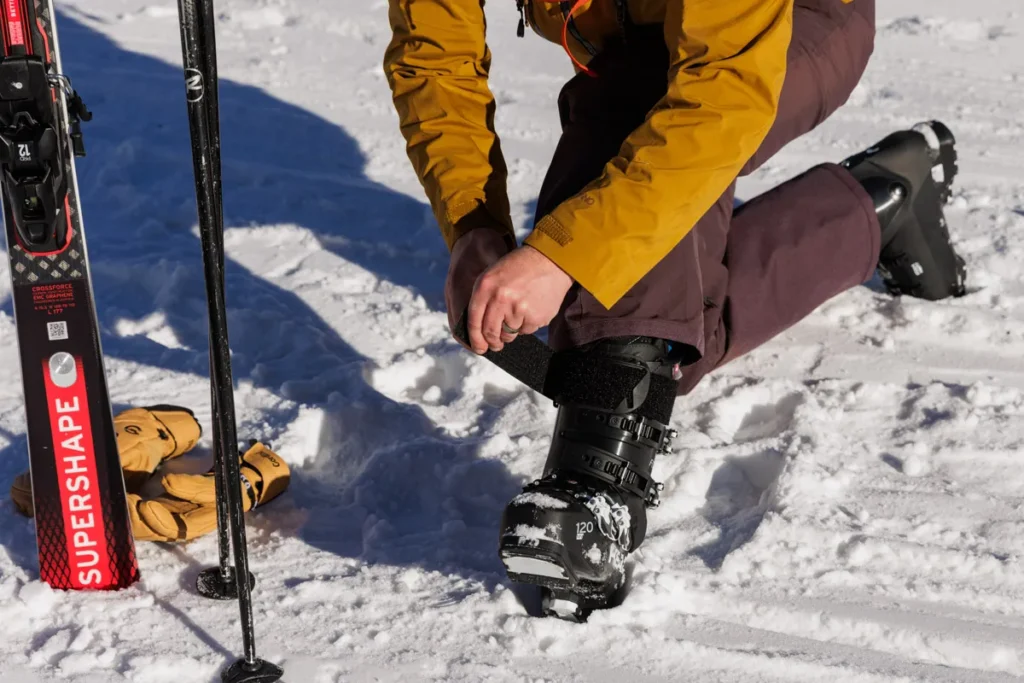
For the beginner, this evolution means that entry-level boots now possess the same DNA as race boots but with thinner wall thicknesses and softer internal liners. We have moved away from the “Rear-Entry” dominance of the 1980s, which prioritized ease of entry at the total expense of heel hold, back toward the “Overlap” (or 4-buckle) design. This shift ensures that even a novice has a direct connection to the ski’s edge, allowing for a more rapid transition from “snowplowing” to parallel carving.
Conceptual Frameworks for Fit and Flex
To evaluate boots objectively, one should apply these three mental models:
1. The Volume-to-Surface Area Ratio
The foot is a lever. If there is air space between the foot and the shell, the lever is inefficient.
-
The Frame: Seek the smallest shell volume that does not cause neural impingement or restrict blood flow.
2. The Progressive Flex Spectrum
Imagine a car’s suspension. A beginner boot should feel like a touring sedan—supple enough to absorb bumps but firm enough not to bottom out during a turn.
-
The Frame: Test the boot’s flex at room temperature, keeping in mind it will be 20-30% stiffer on the mountain.
3. The Heel-Pocket Lock
The most critical point of control is the heel. If the heel lifts while the skier tries to tip the ski, the turn will fail.
-
The Frame: Prioritize a secure heel hold over toe room; toes can be cramped, but a lifting heel is a non-starter.
Taxonomy of Modern Beginner Boot Categories
Selecting from the best ski boots for beginners requires categorizing the hardware based on the user’s foot shape and athletic intent.
| Category | Typical Flex | Last Width | Primary Advantage |
| Comfort/Rental Path | 60 – 75 | 104mm+ | Maximum thermal insulation; easy on/off |
| Sport/Performance | 80 – 100 | 100mm – 102mm | Better power transfer; heat-moldable liners |
| Hybrid/Walk-Mode | 70 – 90 | 102mm | Allows for upright walking in the lodge |
| High-Volume (HV) Specialist | 80+ | 103mm+ | Designed specifically for wide feet/high arches |
Decision Logic for Acquisition
If the user plans to ski more than ten days a year, they should bypass the “Comfort” category and look toward the “Sport/Performance” tier. The slightly higher stiffness provides a “ceiling” for growth that the Comfort tier lacks.
Real-World Scenarios and Fit Constraints
Scenario A: The Athletic Beginner
-
User: A former collegiate athlete with high explosive power but zero ski experience.
-
The Decision: A 90-100 flex boot with a 100mm last.
-
Reasoning: A “standard” beginner boot will be overpowered by their strength, leading to a loss of control at higher speeds.
Scenario B: The “Cold Feet” Casual
-
User: Someone who prioritizes the social aspect and skis only on blue-sky days.
-
The Decision: A 70-flex boot with a “Heat” integrated liner or a plush, high-loft insulation.
-
Failure Mode: This boot will eventually “pack out” (the foam compresses), making the boot feel too large by the second season.
Economics: Total Cost of Ownership and Value Retention
The purchase of ski boots is a capital investment in one’s physical safety.
| Component | Cost (USD) | Lifespan (Days) | Annualized Cost |
| New Beginner Boots | $300 – $550 | 100 – 150 | $3.00/day |
| Custom Footbeds | $150 – $250 | 200+ | $1.00/day |
| Boot Fitting Labor | $50 – $150 | One-time | N/A |
Value Retention: Unlike skis, which suffer from rapid technological obsolescence and physical damage (scratches/core shots), high-quality boots retain their value for several seasons if the soles are protected. Using “Cat-Tracks” or rubber sole protectors is a low-cost strategy to preserve the binding interface.
Support Systems: The Role of Customization
A boot is rarely perfect “out of the box.” The following systems turn a generic shell into a precision tool:
-
Custom Footbeds: The “foundation.” They stop the foot from elongating and splaying, which is the primary cause of toe pain.
-
Heat Molding: Modern liners can be heated in a specialized oven to take the shape of the user’s ankle and shin.
-
Canting/Alignment: Adjusting the lateral angle of the boot cuff to account for “bow-legged” or “knock-kneed” geometry.
-
Booster Straps: Replacing the stock Velcro strap with a dynamic elastic strap to improve shin-to-tongue contact.
The Risk Landscape: Common Selection Failures
Buying boots online without a shell-fit is the most common failure mode in alpine logistics.
-
The “Size Up” Error: Many beginners buy boots one size too large because they feel “right” in the store. Once the liner compresses (after 3 days), the foot slides, leading to “toe bang” and bruised shins.
-
The Over-Buckling Syndrome: If a skier has to overtighten the buckles to feel secure, the boot is too large. Overtightening cuts off circulation and leads to frostbite.
-
Neglecting the Socks: A thick, ribbed “work sock” creates pressure points and traps moisture. A thin, Merino wool ski sock is a mandatory component of the boot system.
Maintenance and Long-Term Adaptation
As a beginner progresses to an intermediate level, the boot requires a “Maintenance Audit.”
-
Review Cycle: Every 20 days, check the thickness of the heel and toe lugs. If they are worn down, the binding release mechanism may fail.
-
Drying Protocol: Never leave boots in a cold car overnight. The plastic will harden, and the liners will remain damp. Use a low-heat forced-air dryer to maintain liner integrity.
-
Buckle Governance: Store boots with the buckles lightly engaged. Leaving them open allows the plastic shell to “warp” or lose its shape over time.
Metrics of Success: Evaluating the Interface
How do you know if you have found the best ski boots for beginners for your specific needs?
-
Leading Indicator: You can wiggle your toes, but your heel does not move when you lean forward.
-
Lagging Indicator: The absence of “burning” sensations in the arches after four hours of continuous skiing.
-
Qualitative Signal: You stop thinking about your feet and start focusing on the terrain ahead.
Addressing Systemic Misconceptions
-
“I need the most expensive boot to be safe”: Price is often tied to weight and stiffness, not safety. A mid-range boot that fits perfectly is safer than a top-tier boot that is too large.
-
“Rear-entry boots are for old people. While rare, modern rear-entry designs have seen a niche resurgence for those with extreme mobility issues, providing a functional solution where overlap boots fail.
-
“Boot heaters are a luxury”: For those with Raynaud’s or poor circulation, heaters are a functional necessity that extends the “operational window” of a ski day.
Conclusion: The Synthesis of Control
The journey to finding the ideal beginner boot is an exercise in technical honesty. It requires the user to prioritize the mechanical connection over the aesthetic appeal. By understanding the interplay of flex, volume, and customization, the novice transforms a potential source of pain into a definitive asset. The “best” boot is ultimately the one that allows the skier to forget it exists, enabling a pure focus on the gravity and grace of the mountain descent.