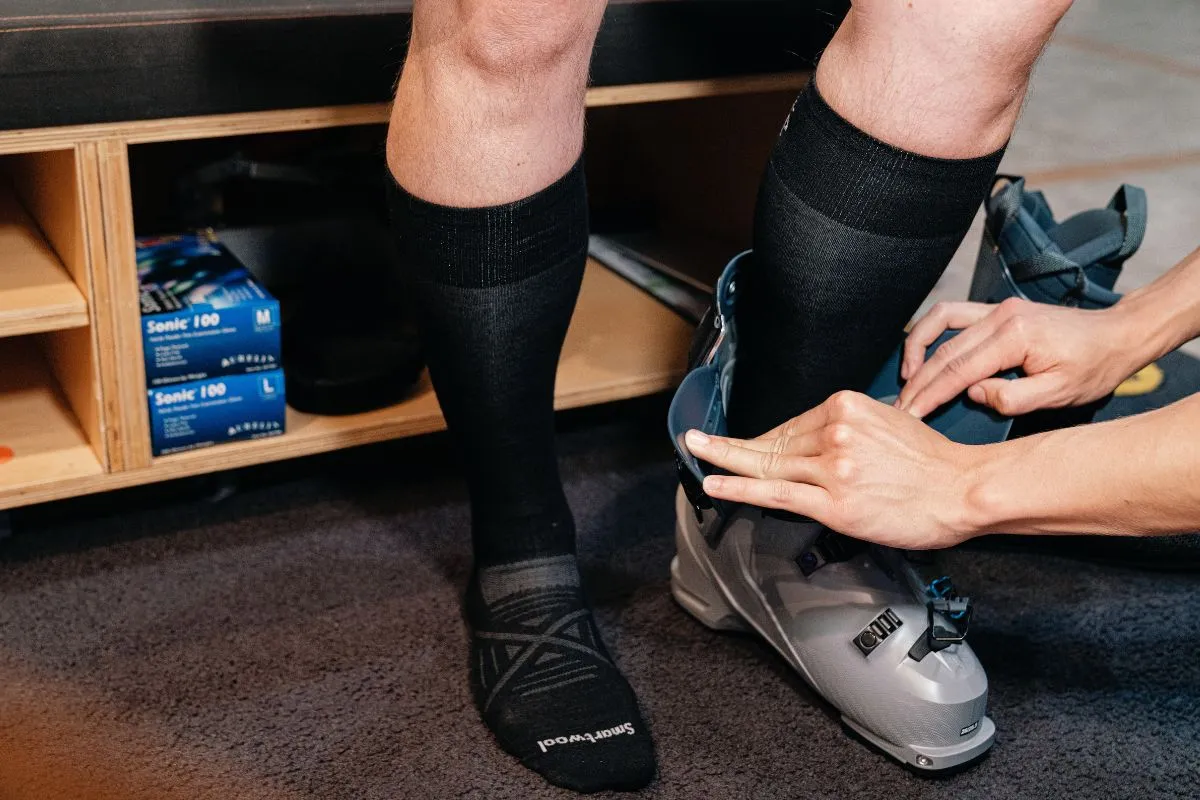
Strategic Alpine Comfort: How to Avoid Ski Boot Pain (2026)
How to avoid ski boot pain. The interface between the human foot and the alpine ski boot is perhaps the most contentious relationship in all of athletics. Unlike the pliable textiles of a running shoe or the forgiving leather of a hiking boot, the ski boot is a rigid, thermoplastic exoskeleton designed to serve a singular mechanical purpose: the uncompromising transmission of kinetic energy from the tibia to the ski edge. In this high-tension environment, the foot is often treated as a secondary consideration, a biological lever forced to conform to a standardized industrial mold. The result, for many, is a chronic state of discomfort that is frequently accepted as an inherent tax on mountain engagement.
True technical mastery in the alpine environment requires a rejection of the “suffer for the sport” narrative. When a skier experiences localized pressure, neural impingement, or vascular restriction, it is rarely a symptom of a weak constitution. Rather, it is a signal of a mechanical mismatch—a breakdown in the systemic integration between the unique morphology of the skier’s foot and the geometric constraints of the boot shell. To address these issues, one must move beyond the superficial application of thicker socks or looser buckles and begin to analyze the boot as a complex piece of orthopedic hardware.
Solving the problem of alpine discomfort demands a forensic approach to fit. It requires an understanding of podiatric anatomy, the thermal properties of modern polymers, and the specific way that gravitational forces redistribute foot volume during a high-velocity descent. This article serves as a definitive pillar of information for those seeking to move past the limitations of “off-the-shelf” performance.
Understanding “how to avoid ski boot pain”
The objective of determining how to avoid ski boot pain is often hampered by a fundamental misunderstanding of what a “good fit” actually feels like. In a retail environment, consumers frequently gravitate toward boots that feel comfortable in a seated, static position. However, this is a profound oversimplification. A boot that feels roomy in the showroom will almost inevitably lead to pain on the mountain. When there is excessive volume inside the shell, the foot slides forward during deceleration, causing “toe bang” (bruising of the nail bed) and forcing the skier to overtighten the buckles, which subsequently restricts blood flow and induces cramping.
Oversimplification also occurs when pain is treated as a localized issue. A burning sensation in the arch of the foot is rarely caused by the arch itself; more often, it is a symptom of a collapsed transverse arch or an unstable heel pocket that allows the foot to splay under load. Similarly, calf cramping is frequently a result of an aggressive forward lean or a cuff height that is incompatible with the user’s muscular geometry. To avoid pain, the strategist must view the foot, ankle, and lower leg as a single, interdependent kinetic chain.
Another critical perspective involves the “Flex Index.” There is a pervasive myth that softer boots are inherently more comfortable. While a soft boot is easier to put on, it provides less structural support. If a skier is too heavy or too aggressive for a soft boot, the shell will deform under pressure, pinching the foot and creating hot spots. The search for comfort is therefore not a search for softness, but a search for “perfect containment”—a state where the foot is held firmly but without neural compression, allowing for precise control without the need for excessive mechanical clamping.
The Evolution of the Thermoplastic Shell
The transition from leather to plastic in the 1960s solved the problem of lateral stability but introduced the problem of rigidity. Early shells were “one-size-fits-many” propositions that relied on thick, foam-heavy liners to fill the gaps between the foot and the plastic. As materials science progressed, manufacturers began using Polyurethane (PU) and Polyether, which allowed for thinner, more responsive shell walls. This paved the way for “heat-moldable” technology, where the plastic itself can be softened in an oven to accommodate bone spurs and wider forefoots.
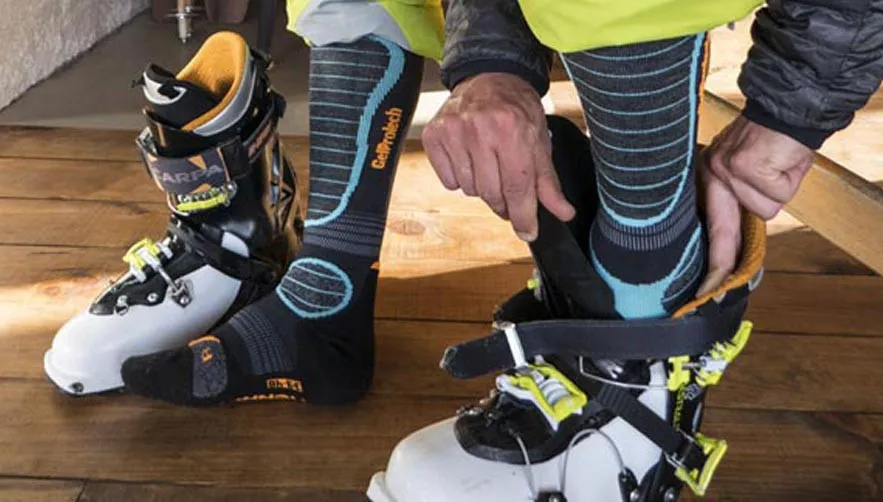
This historical trajectory has led us to the modern “Overlap” shell, which remains the gold standard for power transmission. However, the rise of “Three-Piece” (or Cabrio) designs has offered a significant alternative for those prone to shin bang or high-instep pressure. By utilizing a separate tongue that pivots independently, these boots provide a more linear flex and easier entry, demonstrating that the evolution of comfort is inextricably linked to the geometry of the shell’s opening and closure systems.
Conceptual Frameworks for Fit and Alignment
To diagnose and resolve issues, we can apply three core mental models.
1. The Volume-to-Void Ratio
Every cubic centimeter of “dead air” inside a boot is a failure point. Air allows for movement; movement creates friction; friction creates pain.
-
The Frame: The goal is not “space,” but “uniform contact.” A perfectly fitted boot should feel like a firm, consistent handshake across the entire foot.
2. The Neutral Stance Equilibrium
The human foot was not designed to sit on a 15-degree incline with the lower leg pushed forward.
-
The Frame: If the boot’s internal geometry forces the foot into an unnatural position (pronated or supinated), the muscles will fatigue and cramp. Alignment (canting) is the corrective measure for this imbalance.
3. The Vascular Integrity Model
Cold is the most common precursor to pain. When the shell is too tight over the dorsal (top) of the foot, it compresses the dorsalis pedis artery.
-
The Frame: Prioritize instep height over forefoot width.
Taxonomy of Foot Morphologies and Boot Lasts
[Table: Relationship Between Foot Shape and Boot Last]
| Foot Type | Last Width (mm) | Common Pain Points | Recommended Architecture |
| Low Volume (LV) | 97 – 98 | Heel lift; ankle friction | Narrow, race-inspired shells |
| Mid Volume (MV) | 100 – 102 | General compression | Traditional 4-buckle overlap |
| High Volume (HV) | 104+ | Sixth-toe pressure; instep pain | High-volume shells with wide cuffs |
| High Instep | Variable | Top-of-foot numbness | Cabrio (3-piece) or “Big-Base” shells |
Decision Logic for Selection
The choice of “last” is the single most important decision in the acquisition phase. A common failure mode is a skier with a narrow heel but a wide forefoot buying a wide (HV) boot. This results in a secure forefoot but a floating heel. The correct logic is to buy the narrow boot that fits the heel and have a boot fitter “punch out” the plastic at the forefoot to create room where needed.
Real-World Scenarios and Operational Constraints
Scenario A: The “Sixth Toe” Impingement
-
The Issue: A skier with a wide metatarsal head experiences sharp pain on the outside of the foot after two hours.
-
The Constraint: The shell plastic is too thick to be moved by the liner alone.
-
The Solution: A localized “punch” where a boot fitter heats the shell and uses a hydraulic press to create a permanent pocket for the bone.
Scenario B: The Shin Bang Syndrome
-
The Issue: Severe bruising on the front of the shin, often after skiing in variable or “chopped” snow.
-
The Constraint: A gap exists between the shin and the boot tongue, allowing the leg to “slam” into the boot.
-
The Solution: Using a “Booster Strap” (an elastic power strap) to ensure the tongue stays in constant, spring-like contact with the tibia.
Economics: The Financial Architecture of Comfort
The cost of achieving a pain-free experience is often tiered, involving both the initial capital expenditure and the “soft costs” of professional labor.
| Component | Cost Range (USD) | Longevity | Economic Logic |
| Professional Boot Fitting | $100 – $300 | Lifetime of the boot | High ROI; prevents gear abandonment |
| Custom Footbeds | $150 – $250 | 5 – 7 years | Anchors the foot; prevents splaying |
| Heated Liners/Socks | $200 – $450 | 3 – 4 years | Mandatory for those with Raynaud’s |
| Shell Modifications | $50 – $100 / area | Permanent | Essential for “outlier” morphologies |
Opportunity Cost Analysis: Spending $800 on a flagship ski while using an un-fitted, $400 beginner boot is a misallocation of resources. The “performance ceiling” of the ski cannot be reached if the skier’s foot is in pain. The most efficient financial plan allocates 60% of the hardware budget to the boot-foot interface.
Support Systems: Customization and Orthotics
The “stock” footbed found in 99% of ski boots is a flimsy piece of foam that provides zero structural support. To truly understand how to avoid ski boot pain, one must recognize that the footbed is the foundation of the system.
-
Custom Orthotics: By capturing a mold of the foot in a neutral position, these orthotics prevent the foot from “elongating” when the skier flexes forward. This prevents the toes from hitting the front of the boot.
-
Liner Volume Reduction: Using adhesive foam (L-pads or “donuts”) around the ankle bones to take up space in a boot that has “packed out.”
-
Internal Shims: Placing a thin plastic lift under the liner to take up vertical volume for skiers with low-volume feet.
-
Cuff Alignment: Adjusting the lateral angle of the upper cuff to match the skier’s leg shape (bow-legged or knock-kneed), which prevents “edge-catching” and knee strain.
The Risk Landscape: Compounding Failure Modes
Pain is rarely the result of a single error; it is usually a taxonomy of compounding risks.
-
The “One-Size-Up” Trap: Buying a boot one size too big to accommodate wide feet.
-
Moisture Retention: A damp liner from the previous day’s skiing will compress more easily and conduct cold 25 times faster than a dry one.
-
The Sock Paradox: Wearing two pairs of socks or one “extra-thick” pair actually restricts circulation and takes up room that should be occupied by the foot’s own blood-warmed air.
Governance, Maintenance, and Long-Term Adaptation
A boot is a living system that degrades with every “flex cycle.”
-
The 20-Day Audit: After twenty days of skiing, most liners will have “packed out” by 10-15%. This is the time to visit a boot fitter for a “re-fit” or to add volume-reduction shims.
-
The Storage Protocol: Always store boots with the buckles lightly engaged. If left unbuckled, the plastic can take a “memory” in a flared position, making it impossible to get a secure wrap the following season.
-
Adjustment Triggers: If you find yourself consistently tightening your buckles mid-run, your liners have likely reached the end of their functional life.
Metrics of Success: Evaluating the Interface
How do we quantitatively and qualitatively measure a successful fit?
-
The “Room Temperature” Test: You should be able to wear the boots in your living room for 30 minutes without numbness. If you can’t survive the living room, you won’t survive the chairlift.
-
The Shin-Pressure Leading Indicator: When you flex forward, your heel should feel “locked” into the back of the boot. Any vertical movement is a leading indicator of impending pain.
-
The “All-Day” Qualitative Signal: The ultimate success is “transparency”—the moment you realize you haven’t thought about your feet once during the entire ski day.
Common Misconceptions and Industry Myths
-
“I need a bigger boot because I have wide calves”: This is a cuff-adjustment issue, not a shell-size issue. Many boots have a “spoiler” that can be removed to create calf room.
-
“Ski boots are supposed to hurt”: This is the most damaging myth in the sport. While they shouldn’t feel like sneakers, they should never cause acute pain or numbness.
-
“Custom liners are only for experts”: Beginners actually benefit more from custom work because it provides the stability they haven’t yet developed through muscle memory.
The Synthesis of Technical Comfort
The quest for a pain-free alpine experience is a journey from industrial standardization to individual customization. It requires an honest assessment of one’s own anatomy and a willingness to invest in professional labor rather than just brand-name hardware. When the boot is correctly aligned and the foot is properly anchored, the “pain” of skiing vanishes, replaced by a sense of effortless control. The boot is no longer a cage; it is a conduit.