The Definitive Strategic Framework for Ski Equipment Plans (2026)
Ski Equipment Plans. The acquisition and management of high-performance alpine hardware has moved beyond the realm of seasonal shopping and into a sophisticated domain of asset management. For the dedicated practitioner, the equipment utilized on the mountain is not merely a collection of isolated products but a synchronized system that dictates the boundaries of safety, performance, and physiological endurance. To treat these tools as transient consumer goods is to ignore the complex intersection of materials science and biomechanical feedback that defines the modern skiing experience.
Strategic oversight in this field requires an analytical departure from the standard retail narrative. It involves a deep understanding of how specific polymers, alloys, and carbon composites degrade over time under the stress of thermal cycling and high-velocity impact. A robust approach to alpine logistics prioritizes the compatibility of these systems, ensuring that the energy transfer from the skier’s skeletal structure to the snow surface remains efficient and predictable. This is particularly vital as the industry shifts toward lighter, more specialized equipment that often demands a more rigorous maintenance schedule to remain within its operational safety window.
This inquiry establishes a definitive pillar for long-term equipment strategy. By moving past surface-level reviews and focusing on the underlying mechanics of lifecycle planning, we can develop a more sophisticated understanding of how to maintain a high-performance “quiver” that evolves with the skier. The goal is to provide a technical blueprint that balances the high capital expenditure of new hardware with the logistical reality of mountain environments, creating a durable reference for those who demand technical mastery and intellectual honesty in their gear management.
Understanding “ski equipment plans”
In the context of alpine operations, a “plan” is often conflated with a simple shopping list or a maintenance schedule. However, when we analyze the broader architecture of ski equipment plans, we are actually discussing a dynamic strategy for inventory lifecycle management. This involves a multi-perspective evaluation of how hardware is acquired, maintained, and eventually retired. The failure to view equipment as a unified system often leads to “compatibility debt,” where a high-performance ski is rendered useless by an outdated binding or a boot shell that has lost its structural integrity.
A common oversimplification in this field is the belief that higher price points naturally result in a longer-lasting asset. In reality, many of the most expensive “race-grade” materials are designed for hyper-specific performance windows and may degrade faster than more robust, mid-range alternatives. Therefore, the search for the most effective strategy requires a calculation of “utility per day” rather than simply looking at the initial purchase price. This necessitates a move away from trend-based acquisition toward a more analytical model of functional requirement.
Risk management is another pillar of this planning phase. A plan must account for “unplanned downtime”—gear breakage, lost luggage, or changing snow conditions—by building in redundancy. This might mean maintaining a secondary pair of skis with a different sidecut for varied terrain or having a pre-vetted list of shops capable of handling technical boot repairs. By incorporating these variables, the skier transitions from a reactive consumer to a proactive manager of their own alpine capability.
The Systemic Evolution of High-Altitude Hardware
The history of alpine equipment is a progression from heavy, natural materials to high-modulus synthetics. The shift from wood to fiberglass in the mid-20th century allowed for the mass production of consistent flex patterns, while the introduction of the modern safety binding fundamentally changed the risk profile of the sport. We are currently in an era of “material hybridity,” where manufacturers utilize complex layups of flax, carbon, and titanal to achieve specific dampening characteristics.
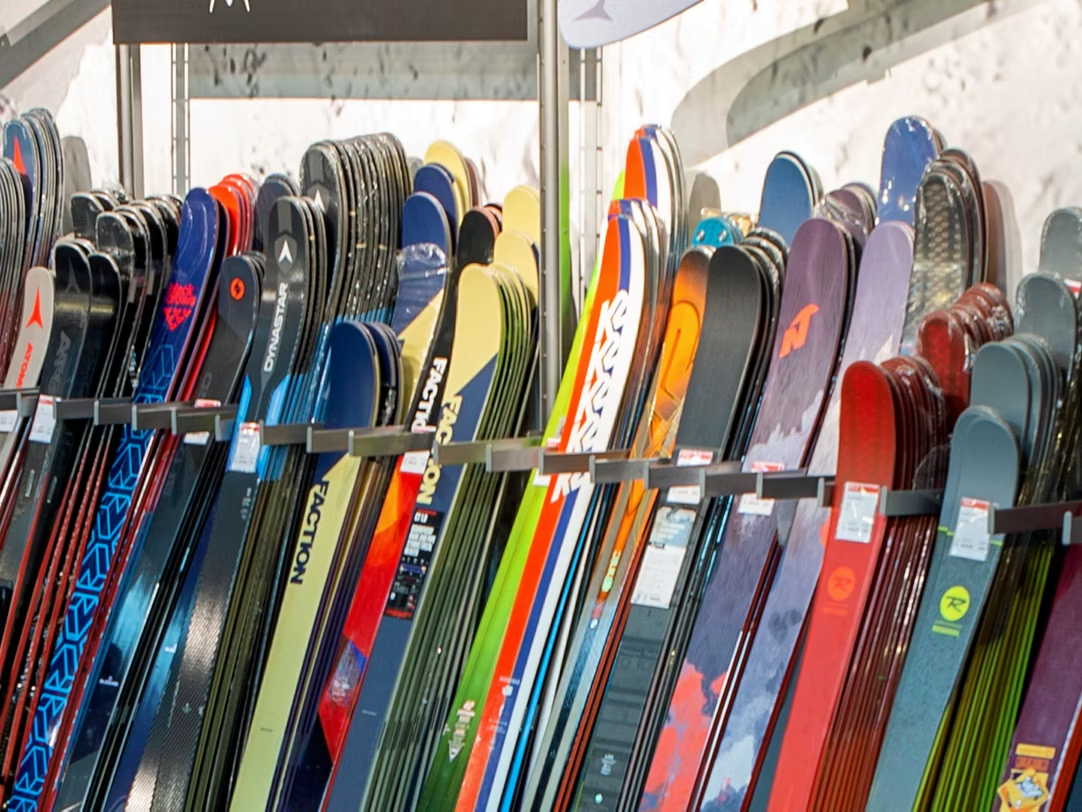
This evolution has significant implications for long-term planning. Modern gear is more capable but often more “brittle” in its application. A carbon-fiber touring ski is an engineering marvel for weight efficiency, but it cannot withstand the same repeated impact on hard-pack as a traditional wood-core alpine ski. Understanding this historical shift is vital; it helps the strategist realize that “newer” is not always “better” for every operational context, but rather more specialized.
Conceptual Frameworks for Inventory Management
To navigate the vast array of available hardware, three primary mental models can be applied to ski equipment plans.
1. The Total System Compatibility (TSC) Model
Every component—from the sock to the ski edge—must be viewed as a link in a chain.
-
The Frame: Evaluate if an upgrade to one component (e.g., a stiffer boot) will necessitate an upgrade to another (e.g., a more robust binding) to maintain balance.
2. The Duty-Cycle Framework
Equipment should be categorized by the intensity of its expected use rather than its price.
-
The Frame: A “daily driver” ski requires a higher durability profile than a “deep powder” ski that may only see 10 days of use per year.
3. The Thermal Resilience Model
Plastics and resins react differently to temperature. A boot that is comfortable in a 70°F showroom may become an impenetrable cage at -10°F.
-
The Frame: Factor in the regional climate of your primary mountain range when selecting shell plastics.
Taxonomy of Equipment Profiles and Systems
Categorizing assets allows for the systematic optimization of the gear closet.
| System Profile | Primary Material | Optimal Terrain | Expected Lifespan |
| Frontside/Carve | Metal Laminate (Titanal) | Groomed, Hard-pack | 150+ Days |
| All-Mountain | Wood Core / Fiberglass | Variable / Off-piste | 100 – 120 Days |
| Backcountry | Carbon Fiber / Paulownia | Untracked Powder | 60 – 80 Days |
| Freestyle/Park | High-Density Wood | Man-made features | < 50 Days (High impact) |
Decision Logic for Acquisition
If the primary goal is “longevity and stability,” the logic dictates a metal-laminate ski. If the goal is “uphill efficiency,” the logic shifts toward carbon, with the understanding that the replacement cycle will be significantly shorter due to material fatigue.
Real-World Scenarios and Operational Constraints
Scenario A: The Multi-Season Resort Professional
-
Constraints: High frequency (80+ days/year), variable ice, and high-speed operation.
-
The Strategy: A plan focused on “heavy” construction to ensure the ski doesn’t “wash out” after 30 days of use.
-
Failure Mode: Selecting lightweight gear for this volume of use will lead to “core fatigue,” where the ski loses its “pop” or rebound.
Scenario B: The Expeditionary Mountaineer
-
Constraints: Remote access, weight-to-stiffness ratio, and field repairability.
-
The Strategy: Standardizing on a single binding type across all skis to allow for interchangeable spare parts.
-
Second-Order Effect: Increased reliance on high-tech skin adhesives that may fail in extreme moisture.
Economics: Capital Expenditure and Opportunity Costs
The financial management of alpine hardware involves both the “hard cost” of the item and the “soft cost” of its maintenance.
| Expense Layer | Range (USD) | Economic Character |
| Primary Hardware | $800 – $1,500 | High Initial CapEx; Depreciating |
| Professional Tuning | $50 – $100 / visit | Necessary OpEx; Extends life |
| Boot Modification | $100 – $300 | Customization; Critical for performance |
| Storage/Insurance | $100 – $300 / year | Protection of asset value |
Opportunity Cost Analysis: Owning a highly specialized powder quiver in a drought year is a misallocation of resources. Often, the most efficient ski equipment plans involve owning the “high-use” items (boots/daily skis) and renting or “demoing” the niche items (fat powder skis).
Support Systems: Integration and Technical Tuning
A ski is an inert object without the support systems that keep its edges sharp and its base planar.
-
The Tuning Bench: Regular “hand tuning” preserves the life of the edge more than machine grinding, which removes too much material.
-
The Boot Fitter: A professional who ensures the foot is neutrally aligned, preventing premature joint wear.
-
Electronic Safety: Regular firmware updates for avalanche transceivers and checking the battery health of heated gear.
-
Base Waxing: Selecting the correct paraffin or fluor-free wax based on the crystalline structure of the snow.
The Risk Landscape: Strategic Failure Modes
The primary risk in managing alpine assets is the “Aspiration Bias”—buying gear for the skier you want to be, rather than the one you are.
-
Mechanical Risk: Binding release failure due to age or improper torque settings.
-
Structural Risk: “Delamination” of the ski core caused by moisture ingress through deep scratches.
-
Physiological Risk: Using boots that are too stiff for the skier’s mass, leading to “shin bang” or nerve damage.
-
Inventory Risk: Having a “quiver” that is too narrow, leaving you unprepared for a significant weather shift.
Governance: Maintenance and Review Cycles
A successful plan requires a “governance” structure—a set of rules for when gear is checked and when it is retired.
-
Post-Trip Audit: Inspecting edges for burrs and bases for “core shots” that require p-tex repair.
-
Mid-Season Review: Checking binding DIN settings to ensure they haven’t shifted due to spring fatigue.
-
End-of-Season Storage: Applying a “storage wax” to prevent the steel edges from rusting and the base from oxidizing.
Layered Checklist for Retirement:
-
Is the edge too thin to be sharpened again?
-
Has the boot liner lost more than 30% of its original volume?
-
Does the ski show signs of “negative camber” (permanently bent)?
Metrics of Utility: Evaluating Asset Performance
How do you track the success of your equipment strategy?
-
Leading Indicator: The frequency of “effortless” turns in varied conditions.
-
Lagging Indicator: The total “days per dollar” spent on a particular piece of gear.
-
Qualitative Signal: The confidence level when dropping into a high-consequence line.
Addressing Systemic Misconceptions
-
“Metal Skis are Only for Experts”: Metal actually provides a “quiet” ride that helps intermediates feel more stable at speed.
-
“Modern Boots Don’t Need Break-in”: Every high-performance shell requires at least 3-5 days of use to “settle” and potentially a few trips back to the boot fitter.
-
“Waxing is Optional”: A dry base is a slow base, and a slow base makes it harder to initiate turns, leading to increased leg fatigue.
Ethical and Practical Considerations
As we look toward the future, the environmental impact of gear production is becoming a central theme in ski equipment plans. Choosing brands that utilize recycled sidewalls, bio-resins, and FSC-certified wood cores is a practical way to support the longevity of the mountain environment. Furthermore, the “second-life” market—donating or selling used gear to entry-level programs—ensures that the barrier to entry for the sport remains as low as possible.
Conclusion: The Synthesis of Alpine Readiness
The effective management of alpine equipment is an ongoing dialogue between the skier and their tools. It requires a rejection of “throwaway” culture in favor of a disciplined, systems-based approach. When the logistics of gear—from the initial acquisition logic to the final retirement audit—are handled with professional rigor, the equipment becomes an extension of the body. In this state of synthesis, the skier is no longer limited by their hardware, but empowered by it, allowing for a total focus on the tactical demands of the mountain.